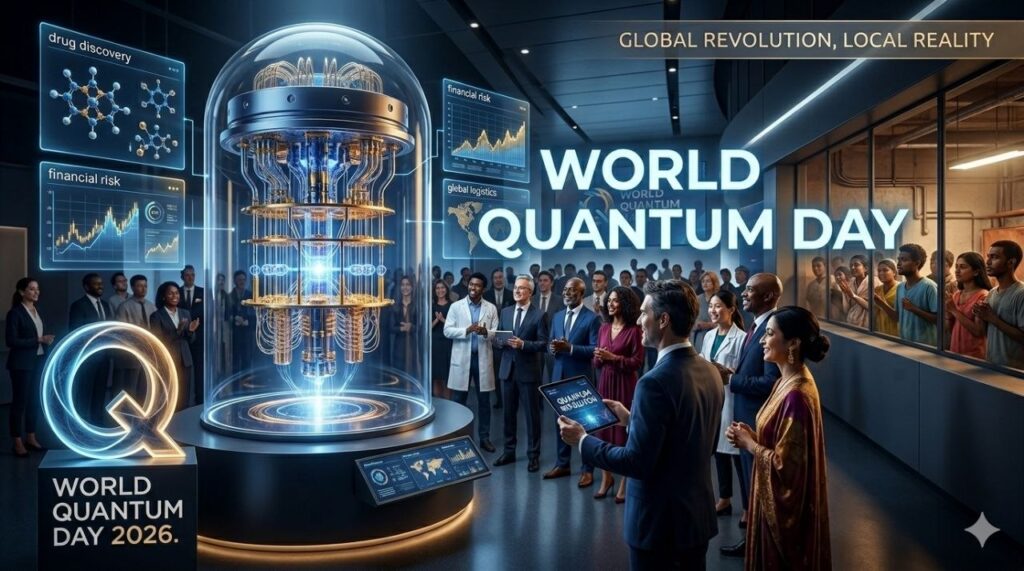
Google made a Doodle for it today. Scientists across 65 countries are celebrating.Politicians are giving speeches about the “quantum revolution.” And most of the world has no idea what quantum computing even is — let alone that it’s quietly building the next great wall between the rich and the poor. Today is World Quantum Day 2026. And before the celebrations wrap up, somebody needs to ask the uncomfortable question: Who exactly is this revolution for?
What Is World Quantum Day 2026? Why Is It Trending Today?
World Quantum Day is celebrated every April 14 — the date chosen because “4.14” represents the first three digits of Planck’s constant. Started in 2022 by scientists from over 65 countries, the initiative now runs more than 400 events globally every year. (Wikipedia) The goal is simple: make quantum science accessible to everyday people. Noble intention. Genuinely. But here’s the gap nobody talks about — between “making science accessible” and actually making sure the technology serves everyone equally. That gap is enormous. And it’s growing.
What Is Quantum Computing? The Simplest Explanation (No Jargon)
Before the sociology, you need the basics. Your laptop processes information as bits — 0s and 1s. On or off. Like a light switch. A quantum computer uses qubits — quantum bits that can exist as 0 and 1 simultaneously. Think of a spinning coin that is both heads and tails until it lands. This property, called superposition, allows quantum computers to process enormous combinations of possibilities at once — opening the door to breakthroughs in medicine, finance, and artificial intelligence. (SpinQ)
What does that mean in real life?
- A problem that takes today’s best supercomputer millions of years to solve?
- A quantum computer could crack it in minutes.
Real-world applications already in development:
- Drug discovery — simulating how molecules interact to design new medicines faster.
- Financial risk modeling and fraud detection.
- Cybersecurity encryption — and breaking it
- Solving complex logistics problems classical computers cannot handle
Quantum computing is estimated to become a $1.3 trillion industry by 2035. (IBM) $1.3 trillion. Let that number sit for a moment. Now ask: who controls that trillion? Who builds it, who owns it, who benefits from it?
The Quantum Divide: How This Technology Is Creating a New Global Inequality
Here’s what the World Quantum Day press releases won’t tell you.Scientists and policymakers have explicitly warned that without coordination, quantum technologies could entrench inequality by concentrating infrastructure, expertise, and economic returns in a handful of wealthy nations. (APS Physics) Only 17 countries have meaningfully invested in quantum technology development. The rest of the world is watching from outside.
Export controls by the US, EU, and China are already limiting access to quantum hardware and software in the Global South — undermining research capacity and infrastructure development in poorer nations. The absence of a cooperative global framework could leave these countries more vulnerable to security threats and deepen digital dependency. (The Quantum Insider)
Think about what that actually means:
- The countries that most need medical breakthroughs will be the last to access the technology that enables them
- The financial systems of developing nations could become obsolete overnight when quantum computers crack current encryption
- The jobs, the patents, the intellectual property — all concentrated in a few zip codes in the US, China, and Europe
If the AI-quantum transition is managed unevenly, it risks entrenching a quantum divide — one far harder to bridge once it is built into the system’s architecture. (World Economic Forum) This isn’t speculation. This is already happening.
How Power and Technology Always Work Together — What Sociologists Warn
Karl Marx wrote about how those who control the means of production control society itself. In the 19th century, that meant factories and land. In the 21st century, it means data, algorithms — and increasingly, quantum processors. Sociologist Thorstein Veblen introduced the concept of technological determinism — the idea that technology doesn’t arrive in a neutral space. It arrives in a world already sorted by wealth, geography, and political power. And it amplifies whatever structure it finds.
- The printing press amplified literacy — but also propaganda
- The internet democratized information — but also surveillance
- Quantum computing will cure diseases — but whose diseases first?
We see this pattern not just in tech, but in our most intimate social structures—[just as the ‘Baby Bust’ in America is driven by economic architecture rather than mere personal choice], the quantum divide is being built into the world’s financial architecture.
The OECD has explicitly warned that heavy investment by wealthier nations risks excluding lower-income countries from the quantum revolution, worsening global economic divides. (The Quantum Insider) This is not a technical problem. It is a deeply sociological one. Immanuel Wallerstein’s World Systems Theory described the global economy as permanently divided — core nations that dominate and peripheral nations that serve. Technology has always been one of the primary mechanisms of that dominance. Quantum computing isn’t changing that structure. It’s deepening it.
What Is “Qubits for Peace” — And Can It Fix the Quantum Inequality Problem?
Researchers at Dalhousie University and UCLA Law recently published a striking proposal. They drew a comparison to 1953, when President Eisenhower launched “Atoms for Peace” — an attempt to share nuclear energy technology globally while limiting its weaponization. The researchers asked whether a similar framework — which they called “Qubits for Peace” — could work for quantum technology, enabling peaceful applications in less developed countries while safeguarding military uses. (The Quantum Insider)
It’s a compelling idea. But here’s the reality:
- The US sees quantum as a national security asset
- China has made quantum supremacy a state priority
- The EU is racing to not be left behind
None of them are losing sleep over whether Ghana or Bangladesh has access to quantum infrastructure. Sociologist C. Wright Mills called this the power elite — a small network of political, military, and corporate leaders who make decisions that affect millions, without those millions ever being in the room. The quantum future is being decided right now. And most of the world isn’t in that room.
Why World Quantum Day 2026 Matters More Than You Think
Experts estimate that a “quantum break” — the moment when quantum computers can crack widely used public-key encryption — could arrive in the 2030s. For a regional bank or small exporter in the Global South, failing to meet new quantum-safe standards won’t just increase risks — it could mean being cut off from insurance, correspondent banking, and global trade entirely.
This isn’t a future problem. The preparation has to happen now.And yet, most governments in the developing world aren’t even in the conversation. The pattern is not new:
- Industrial Revolution → wealth concentrated in Europe and America
- Digital Revolution → Silicon Valley captured most of the value
- AI Revolution → same handful of companies, same handful of countries
- Quantum Revolution → same story, higher stakes
Every technological leap has promised to lift all boats. Every time, it mostly lifted yachts.
What World Quantum Day Should Really Be Celebrating
Celebrations are fine. Science is genuinely worth celebrating. At the closing ceremony of the International Year of Quantum Science in Ghana, speakers called for shared infrastructure, regional facilities, and coherent national strategies aligned with local priorities — not imported ones. (APS Physics)
That’s the conversation World Quantum Day should be centering. Not just the Google Doodle. Not just the lab announcements. The question of who gets to be quantum-ready — and who gets left standing outside the door when the next era begins. Because here’s the thing about revolutions: They always sound universal in the beginning.
The printing press was going to democratize knowledge for everyone. The internet was going to connect the whole world equally. And they did — partially. For some. Under specific conditions. With enormous gaps remaining.
Quantum computing will be exactly the same — unless we make deliberate, structural decisions right now to prevent it.Today, on World Quantum Day 2026, the question isn’t just “what is quantum computing? “The question is: what kind of world do we want quantum computing to build? And who gets a say in that answer.