The world’s most expensive electric car just launched. Saving the planet never looked so exclusive. On May 25, 2026, Ferrari officially crossed its Rubicon, unveiling the Ferrari Luce—a striking, all-electric supercar carrying a breathtaking price tag of €550,000 (roughly $640,000). For the automotive world, it’s a engineering milestone: silent speed, zero emissions, and the iconic prancing horse.
But step outside the garage and look through a sociological lens, and the Luce represents something much deeper. It is the ultimate artifact of Green Capitalism—a shiny, carbon-fiber proof of concept that the elite have figured out how to commodify the climate crisis, turning survival into the ultimate status symbol.
Here is why the Ferrari Luce isn’t just a car, but a masterclass in how ultra-luxury aesthetics are hijacking environmentalism.
1. Beyond Wealth: The Rise of “Conspicuous Conservation”
To understand the social gravity of the Ferrari Luce, we have to revisit the turn-of-the-century economist and sociologist Thorstein Veblen. In 1899, Veblen coined the term Conspicuous Consumption to describe how the leisure class used wasteful, expensive goods to broadcast their economic power. A roaring, gas-guzzling V12 Ferrari was the textbook definition of a Veblen good. But in 2026, the rules of elite distinction have evolved. Enter Conspicuous Conservation.
Today, wealth alone is no longer enough to secure the highest rungs of social prestige; you must also possess moral authority. The ultra-rich are no longer just flaunting what they can afford to waste; they are flaunting how much they can afford to save. The Ferrari Luce is the apex of this shift. It allows the billionaire class to retain the raw, predatory social status of a supercar while sanitizing it with the guilt-free, socially praised tag of an EV. You aren’t just driving fast; you are driving correctly.
2. Bourdieu’s “Eco-Chic” Cultural Capital
Why buy a $640,000 EV when a $40,000 mass-market electric car reduces carbon footprints just as effectively? French sociologist Pierre Bourdieu provided the answer through his framework of Cultural Capital and Distinction. Bourdieu argued that the dominant class maintains its position not just through money (economic capital), but through taste, lifestyle, and internalized codes of consumption (cultural capital).
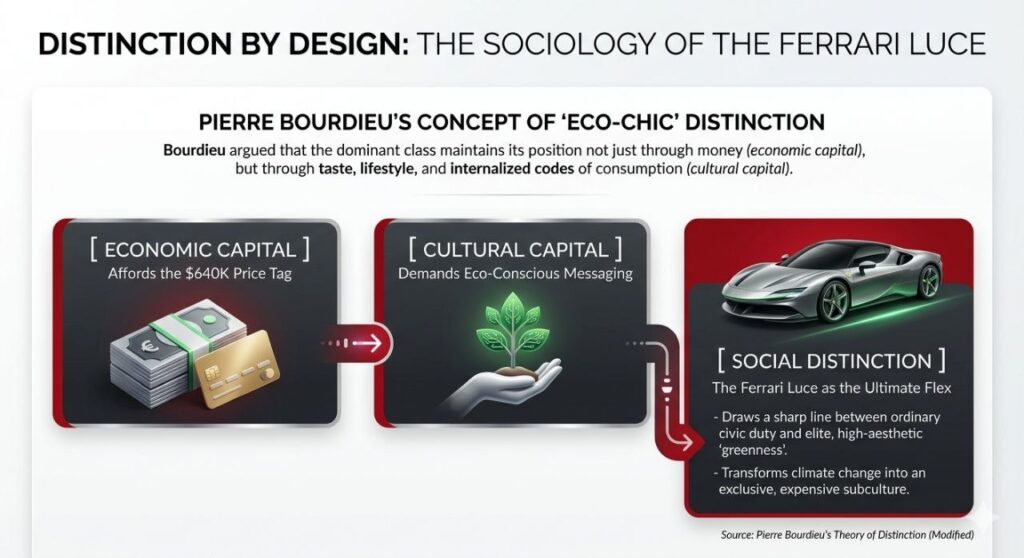
If you advocate for the environment while driving a mass-market hatchback, you are simply participating in a baseline civic duty. But when you do it behind the wheel of a Luce, you transform sustainability into an elite, unattainable lifestyle. The vehicle becomes a tool of social stratification. It draws a sharp line between:
- The ordinary citizen who must ration electricity or use public transit.
- The elite consumer whose “greenness” is lavish, unrestricted, and highly aestheticized.
The Luce successfully transforms the existential threat of climate change into an elite subculture—an “eco-chic” playground where the entry fee is over half a million dollars.
3. The Grand Illusion of Green Capitalism
The systemic critique here belongs to the school of Green Capitalism—the economic ideology that we can consume our way out of a crisis caused by overconsumption. The marketing narrative around the Ferrari Luce suggests a heroic corporate pivot toward zero emissions. But sociologically, it functions as a form of structural eco-washing. Producing a luxury EV requires intense, specialized resource extraction—lithium, cobalt, and rare earth elements—often mined under deeply unequal conditions in the Global South.
By framing a 640-horsepower luxury toy as an environmental victory, green capitalism accomplishes two things simultaneously:
- It absolves the ultra-wealthy of the disproportionate carbon footprints caused by private jets and mega-mansions.
- It reinforces the illusion that market-driven luxury, rather than radical systemic change, is the solution to ecological collapse.
4. The Climate Inequality Gap: Who is “Green” Really For?
The ultimate irony of the Ferrari Luce lies in the sociology of Environmental Injustice. Statistical data consistently shows a stark asymmetry: the demographics and regions that suffer the first and most devastating consequences of climate change—heatwaves, displacement, air pollution, and resource scarcity—are those who contribute the least to global emissions. They are also the demographics entirely locked out of the luxury EV market.
When the solution to a global crisis is commodified at $640,000, “saving the planet” ceases to be a collective human endeavor. It becomes an exclusive insurance policy for the affluent. The Luce embodies a glaring paradox: the vehicle built on the rhetoric of protecting our shared future is entirely inaccessible to the very people who need a stable future the most. In fact, while the global elite buy moral peace of mind with luxury EVs, systemic anxieties are forcing ordinary people to make radical personal sacrifices—evident in the skyrocketing global trend of couples choosing to remain [childfree by choice] due to climate doom and economic instability.”
Conclusion: A Silent Revolution or a Loud Flex?
The Ferrari Luce is undeniably a masterpiece of automotive art. But it is also a mirror reflecting the anxieties and strategies of the modern elite. It proves that in the contemporary socio-economic landscape, even the apocalypse can be optimized for branding. By merging high-end performance with moral superiority, Ferrari hasn’t just built an electric car; they have successfully monetized the climate conscience. As the Luce silently accelerates from 0 to 60, it leaves behind a loud, unmistakable message: the planet is changing, but class dynamics remain exactly the same.