She walked into the White House Grand Foyer yesterday. Read a six-minute statement. Denied everything. Called for justice for Epstein’s victims. Then walked away without taking a single question. America lost its mind.
And almost nobody stopped to ask: why does a woman have to publicly defend herself against a dead man’s shadow?
Melania Trump Epstein Statement: What She Actually Said
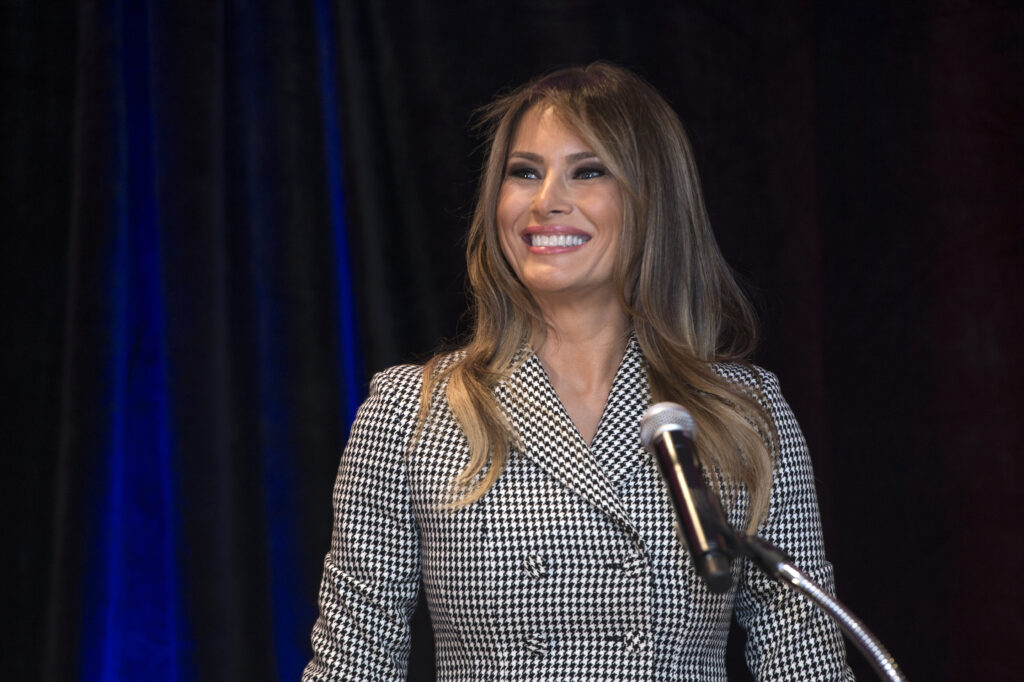
Yesterday, Melania Trump stood at the White House and said: “The lies linking me with the disgraceful Jeffrey Epstein need to end today.” (White House) She was clear, direct, and unusually forceful — for her.
- She denied ever being friends with Epstein, denied being his victim, denied that he introduced her to Donald Trump. (White House)
- She called on Congress to hold public hearings for Epstein’s survivors — letting every victim testify under oath, on record, permanently entered into Congressional history. (CBS News)
- That call directly undercut her own husband’s messaging. Trump and his administration had been trying to move past the Epstein story. She just dragged it back to center stage.
Trump later told reporters he “did not know anything about” the statement ahead of time. (NBC News) Whether you believe that or not — the sociology of what just happened is fascinating.
Melania Trump and Epstein: Why Is Her Name Even in This Story?
Here’s the uncomfortable truth nobody’s saying clearly: Old photos of the Trumps with Epstein and Maxwell have been publicly available for years. Justice Department emails revealed that Melania and Maxwell corresponded at least once over email. (CBS News) That’s it. That’s the entire basis.
She was at parties in the same social circles. She exchanged one email with Maxwell. She was married to a man who called Epstein “a terrific guy” in 2002. And somehow, her name became part of this story. Sociologist Erving Goffman called this stigma by association — the process by which a person absorbs the social taint of those they are connected to, regardless of their own actions.
Melania didn’t do anything. But she existed in proximity to people who did. And in the court of public opinion, proximity is enough.
Melania Trump Statement Today: The Woman Who Built Power Through Silence
Author Kate Andersen Brower, who wrote First Women, described Melania as “the most obviously unknowable first lady” — adding: “First ladies are expected to want to please people. I’m not sure she really cares.” (SheKnows) This is not a weakness. It’s a deliberate strategy.
Biographer Mary Jordan found that Melania “crafted her image by withdrawing, by silence” — watching Donald Trump build his brand by talking constantly while she did the opposite. (National Press Club) Think about what that means sociologically. In a political world built on visibility, performance, and constant self-narration, Melania chose radical non-performance.
Goffman’s concept of impression management — the idea that we are all constantly performing for our audiences — assumes that everyone wants to be seen. Melania’s entire strategy has been to refuse that game. And it worked. For a long time.
How Old Is Melania Trump and Why Does That Question Even Trend?
She is 55 years old. She was born in Slovenia, then part of Communist Yugoslavia. She built a modeling career across Europe before coming to New York. She became a US citizen in 2006. But here’s what’s sociologically interesting about that trending search: The role of First Lady has never been constitutionally defined. She is not elected, receives no salary, and has no official job description — yet every woman who steps into that role becomes a screen onto which the nation projects its ideals, anxieties, and evolving ideas about womanhood and power. (The Conversation)
We search “how old is Melania Trump” because we are constantly trying to locate her — to pin her down, categorize her, understand her through the frameworks we use for women in public life.She refuses to cooperate with those frameworks. So we keep searching.
Where Is Melania Trump From — And Why It Matters More Than You Think
She is from Sevnica, Slovenia. She is the only First Lady in US history who grew up speaking a language other than English as her first language. The second foreign-born First Lady ever. What particularly fascinated her biographer was Melania’s status as an immigrant whose husband has made anti-immigration a cornerstone of his political identity. (National Press Club)
This contradiction sits at the heart of everything. She arrived in America through the exact systems her husband seeks to restrict. She built her life through the kind of international mobility that his policies make harder for millions of others. Sociologist Stuart Hall talked about cultural identity as contradiction — the idea that identity is never fixed, never simple, always composed of tensions that cannot be neatly resolved.Melania is the living embodiment of that tension. And the public doesn’t know what to do with it.
Melania Trump Epstein Connection: What the Survivors Actually Said
This is the part the media moved past too quickly. A group representing survivors and family members of Virginia Giuffre — a prominent Epstein survivor who later died by suicide — responded to Melania’s statement by saying her call for hearings “is a deflection of responsibility, not justice.”
Their full statement:“First Lady Melania Trump is now shifting the burden onto survivors under politicized conditions that protect those with power.”
Read that again. The survivors — the people this entire conversation is supposed to be about — said that asking them to testify publicly, under political spotlight, while the Justice Department has still not fully released the Epstein files, protects the powerful. It doesn’t serve the victims. It performs concern for them. This use of language to manage public perception is a classic example of how scripts are written to control the story—a pattern I’ve also analyzed in my recent piece on [How Media Frames the Iran War: A Real Story or a Script?]
Sociologist Patricia Hill Collins wrote about matrix of domination — how systems of power work not through individual villains but through institutions, processes, and performances that look like accountability while actually maintaining the status quo. Melania’s statement was powerful. It was also, whether intentionally or not, a masterclass in political deflection.
The Deeper Question Nobody Is Asking
Here’s what yesterday’s moment was really about: A woman had to stand at a podium — in the most powerful building in the world — and publicly deny that she knew a convicted sex trafficker. Not because any evidence links her to his crimes.But because she existed in his orbit. Because photographs exist. Because one email exists. Because she was a woman in a room with powerful men and that, apparently, requires explanation.
Melania said it herself years ago: “People, they don’t really know me. People think and talk about me like, ‘Oh, Melania, oh, poor Melania.’ Don’t feel sorry for me.” She doesn’t want pity. She never did.But pity isn’t really what’s being offered anyway. What’s being offered — from all sides — is projection. She is a blank screen onto which people pour their anger at Trump, their sympathy for Epstein’s victims, their discomfort with powerful silence, their fascination with immigrant women who refuse to explain themselves.
The real Melania — whatever she actually thinks, feels, believes — remains exactly where she has always been. Out of reach. By design.